Featured

Monster Monday: Rakshasa

Rakshasa! (Rock-Sha-Sa)

Rakshasa are one of the lesser used creatures of the Monster Manual. It has a high CR and it can only be used in specific types of quests, which really backs it into a corner. I would also like to blame the picture of it a little bit. Who is going to want to fight this cool… cat *groan*

Rakshasa in its true forms. A humanoid cat with… backward hands?

The above picture is the Rakshasa in its true form, backward hands and all. Because honestly what’s more spooky than backward hands. So what are Rakshasa? They are essentially fiendish doppelgangers that try not to get caught. Let’s dive a little bit more into that question below…

What in the Nine Hells is a Rakshasa?

Imagine a powerful devil living deep within the Nine Hells. They want more than anything to get up to the Material Plane, where they can devour humanoids and maybe even hatch an evil plan or two. From that desire, they discover or create a dark ritual that allows their essence to travel into the Material Plane, leaving their body behind to rot. Once they arrive, their essence is able to transform into whatever form they choose, typically a creature of high influence, such as a noble. From there they use their high charisma and the occasional Charm Person to maintain their influence and status, while occasionally devouring a humanoid as needed.

Additionally, they work very hard to keep their identity a secret from anyone, especially those that may want to hunt it. If your players somehow discover the Rakshasa it will try to leave as quickly as possible. Its survival is number 1, never caring about any material items. If they then somehow pin it into an encounter, the Rakshasa will attempt to escape as its first priority, using its powerful magic to assist it. IF they manage to kill it, its essence is sent back to the Nine Hells where it is tortured for months or even years waiting for its body to be recreated. One thing is for sure though: the Rakshasa will return to the Material Plane, it will hunt down the party, and it will attempt to make them pay for what they did to it. And that’s where things get the most interesting.

Rakshasa Stat Breakdown:

At a quick glance, it’s AC and Speed are where you would expect them to be, but it’s HP is incredibly low for a creature that should rightfully be the BBEG of an adventure. But as you continue on down the stat sheet, it becomes apparent. Rakshasa are immune to physical damage from nonmagical weapons, which will be difficult for a lot of typical fighter-types. On top of that, they are immune to any spells level 6 or lower. With their CR a party of 4 should be level 8 when taking on a CR13 creature, but a Rakshasa will be a touch kill until level 14, which then makes it an easy kill. There is no in between for Rakshasa. They are the ultimate “make them fear me while they’re young” Big Bad.

Rakshasa has a melee attack, but it doesn’t do very much. Remember, a Rakshasa just wants to escape any confrontation, and its attacks and spells back that up. In fact, it has no spells that cause damage to the players. It does have a large repertoire of spells that can ease its escape plan. Charm Person, Dominate Person, Invisibility, and Fly are all of its go-to spells.

One big positive for your players: it is vulnerable to piercing damage from magical weapons wielded by good creatures. Very specific, but if you have a “Good vs Evil” campaign, this will play a role.

Rakshasa Strategy:

If caught, the Rakshasa will make a quick escape, likely leaving town before your players can even encounter it. If they do manage to pin it down, it will use its spells wisely to continue the escape. If cornered, the Rakshasa will either escape or die, using it’s best spells to escape as it gets desperate. If it dies, the players can follow it the Nine Hells, where they will encounter a very powerful devil (such as a Horned Devil, Erinyes, Ice Devil, or Pit Fiend). If it dies here, it dies permanently.

Otherwise, that Rakshasa will seek retribution against its foes, likely through a way of destroying their reputation instead of a head-on attack. If it wishes to end them, or if it escapes an initial attack, it will draw the party into a long dungeon crawl. This dungeon would be filled with devils it was able to summon, as well as difficult magic puzzles. If they make it to the end, the Rakshasa will be waiting with several additional fiends ready to make their last stand.

A lot of fun quests or adventures can have a Rakshasa puppetmaster tying it all together. Be creative and make sure to think like a Rakshasa.

Monster Monday: Death Knight

Yes, sadly I did not get a chance to post last week. Work got the better of me. But I am going to be making it up to you all by posting one of my favorite undead creatures: The Death Knight!

These failed Paladins have a lot going on and can be intimidating to you (and your players). They are powerful fighters AND spellcasters with a slight tendency to travel with friends. All of this makes them very dangerous and very difficult to control. That’s why we are breaking it down for you below.

Death Knight Basics

Let’s start with a quick look:

  • Give your Death Knight a backstory. The quick read of Lord Soth in MM gives a great example of what tragedies these Undead went through in life. More on this in a bit.
  • Highhhhh AC.
  • Decent HP. More than enough when you consider what your players are going to encounter with Death Knights.
  • Sword Skills AND Spellcasting!?
  • Dexterity and Intelligence are low but fixes the Dex issue with a high save. And how many Intelligence Saving Throws are there? Four?
  • The Marshal Undead feature is the most interesting piece of the Death Knight, that gives A LOT of insight into what their home life is like. More to come.
  • MM gives a cool alternative of fiend followers instead of undead. Wait, followers? Well, that just supports the Marshal Undead idea I had…

That Cool Marshal Undead Feature

I promise I’m not obsessed with this feature. Well… maybe a little, but only because it sets the scene of your encounter with your Death Knight. Marshal Undead simply allows undead within 60 feet to have advantage on saving throws that turn undead. So looking at the Death Knight’s spells… it can’t summon undead. So how are these mouth breathers (Undead Nature means they don’t need air) there in the first place? Easy. They’ve always been there.

Death Knights don’t have Lair Actions, and for a good reason, they don’t have a lair. Reading the story, a Death Knight is made from a Paladin who has died which has fallen from grace. Typically these guys were on a mission of atonement and died. What are the enemies of most paladins? Undead. That’s why Oathbreakers have powers over Undead. So these guys more than likely died surrounded by Undead, and then uh-oh a band of travelers ends up battling some zombies, ghosts, ghasts, wraiths, etc…. and now a brand new cool Death Knight.

So how much is a “following”? Depends on how interesting you want to make this. I know a Paladin isn’t going to simply fall to 1 or 2 Zombies. but 8 Wraiths and 4 Zombies, and a Ghost would do the trick. I would say anywhere from 8 to 14 is a good amount. Lower than CR6 and Vampires definitely don’t make sense.

Now let’s talk about that alt version. Fiend Followers. And the Death Knight doing the bidding of a Fiendish leader. AND the Death Knight racing in on a Skeletal Horse? Sign me up! But doesn’t that make this whole feature pointless? Yes. Yes, it does. But you’re the DM. Feel free to Homebrew a new feature. The Fiends are resistant to Necrotic damage within 60 feet. Or they have advantage on Constitution Saving Throws within 60 feet. Those will definitely make it interesting.

The Encounter

So now we basically base our whole encounter on this feature. Ask yourself a few questions after you know the Death Knights backstory. Is he the BBEG of this quest or is it simply the right-hand man of the BBEG? Will your team awaken him or will he come upon them? Fiend Followers or Undead Followers?

Broken down, you basically have 2 options.

  • The Death Knight has been lying dormant surrounded by undead creatures for decades. He awakens when the players arrive at his tomb.
  • The Death Knight and his Fiendish followers scorch the plains of ____ in search of ____ and killing your players will help him get to it.

Battle Of The Death-ade *groan*

I’m sorry.

But if you do this encounter the right way and it will become legendary in your group. My first (and only) Death Knight encounter, included 3 Ghosts, 3 Zombies, 3 Wraiths, and 3 Wraiths. We had a Paladin (who was close to breaking his Oath), a Bard, a Sorcerer, a Ranger, and a Monk. The encounter was meant to warn the Paladin of what could happen if his oath broke (it didn’t work, he died to a dragon soon after *shoulder shrug*). I used each of the undead to attack the player least equipped to handle the specific type and knowing the Paladin loved to go one on one, knew he would go after the Death Knight.

Death Knights are similar. While they have very powerful magic, they really want to go toe-to-toe against the best fighter in the group, especially another Paladin.

Death Knights have nothing to fear from spellcasters. They have advantage and high saving throws for everything except Intelligence. But if one gets annoying (especially a Wizard or Cleric) or if there are multiple strong fighters, it can use Banishment to take it out for a bit.

How does the Death Knight use its spells? Command is useful if it needs to get rid of someone. Compelled Duel is good if the fighter it wants to slay is avoiding him, and it’s the main use of its 1st level slot. Hold Person will be how it uses all, if any, of its 2nd level slots. Make that slippery Rogue stand still. Honestly, it probably won’t use it’s 3rd level slots unless it has to get rid of a magical effect. Banishment will absolutely be used for round 2. And that will make all other concentration spells worthless. Finally, does it need to hurt everyone in the room? Destructive Wave…. and it can use it twice.

So I mentioned round 2 is a spell, so what does it do first? What is it’s opening move? The Death Knight will almost always use Hellfire Orb first round. It deals a devastating amount of damage from the start. A potential 70+ points or 35+ points on a failure. It could make everyone think twice about getting too close.

And to top it all off, the Death Knight has a Parry reaction which puts its AC to 26. Your high-level fighter with a +12 to hit? Yeah, it only has a 30% chance to hit this guy. It’s gonna be a tough battle. I would put its CR (including it’s undead friends) at an actual 20 instead of 17.

Monster Monday: Behir

Monster Monday round 2! This time we are focusing on Behirs. Clearly, I only post monsters that start with the letter “B”, maybe I will continue the streak next week. Have an idea for the next monster? Post a comment below!

Just as I said last week, we want to focus on what is in the Monster Manual, so if information on Behirs is contained elsewhere, I try not to focus on it.

Behir Basics:

Behirs were created (yes, created) long ago by Storm Giants to fight against the dragons of old. And looking at their stats, they match up well against them. They are huge, quick, stealthy, and full of hit points. A Behir rarely will set up its lair near a dragon. If one moves in close, the Behir will either drive it off or leave itself. Behirs are highly territorial, and rarely will live close to another of its type, let alone let travelers pass through. Behirs typically set up their lair in large caverns or deep pits. They have a very good climbing speed and while not climbing, can fold in their arms and slither like a snake to move faster.

A Behir has better darkvision than your typical player, as well as high passive perception. Therefore, the Behir will rarely let anything sneak up on it. The Behir has a high enough intelligence to at least corner themselves in the lair to not allow anything to literally stab it in the back. More likely, the Behir is going to try to strike first. The Behir knows Draconic, but with its intelligence, it likely doesn’t care for what intruders have to say.

Behir Attack & Strategy:

Behirs have a large array of attacks that it can use. Like I said before, the Behir will attempt to go first, ideally up on a wall or ceiling, and it will always always ALWAYS use its lightning breath first. It guarantees damage and is its strongest attack, while also requiring a recharge. Typically recharge attacks will be used first so that they have more chances to recharge. IF SOMEHOW the Behir is snuck up on and has two or fewer creatures within melee range at the start of it’s turn, it will use its Multiattack instead.

The Behir will use its Multiattack whenever it does not have its Lightning Breath. It always starts with its Constrict attack, so that if it hits with both the creature is also swallowed. The Behir will use this as intimidation as needed.

The Behir will also always move on its turn, and when possible (almost always possible in its lair), climb up the walls. This helps keep it out of melee range, while also keeping it’s attacks possible.

Feel free to comment below or contact us on what you want our next Monster Monday to be. Follow us on Instagram for photo updates of our projects, more advice, and encounter ideas.

Puzzle: Beholder in a Bottle

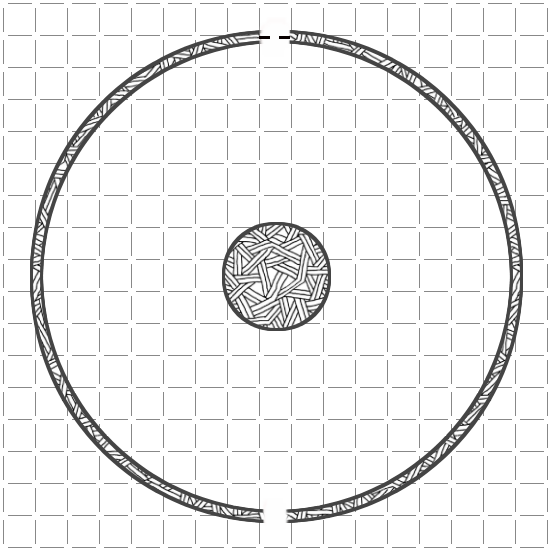
Map of the first/top room of this tower.

Description:

The bottom of the map is a simple archway into a round room. In the middle of the room sits a 15ft cylinder. The ceiling is 30ft up, which is a simple stone ceiling. The room is clearly split into four different sections. The NW quadrant is made of white stone, with intricately carved battle scenes with a black dragon. The NE quadrant is made from grey stones covered in green moss. It seems as though there were carvings long ago, but have since whittled away, requiring a DC25 Perception check to find a head of a green dragon behind the moss. The SE quadrant is made entirely out of red brick, carefully placed and almost perfect. A small red dragon is carved into each brick. The SW quadrant is made from some sort of enchanted ice that does not melt. Behind the ice, requiring a DC15 Investigation check to find a white dragon carving. The ice is difficult terrain.

The cylinder goes to the ceiling and is made out of a thick clear glass. Looking down under the cylinder shows that it is open on the bottom, with treasure down below. Up at the top is a Beholder watching the archway entry. He reacts when the party enters the room, but we will get there in a moment.

The door on the far side is a double door. The door is magically locked and cannot be opened without the keys. You may choose to allow the door to be opened, but it would lessen the puzzle portion. The door is made out of beautifully carved pieces of glass, each about the size of an orange. The glass ranges in colors, going in a specific order (White, Green, Red, Blue, and Black), and do not mix or fade. The door is missing one of each of these colors.

The Puzzle:

Each time the Beholder shoots one of it’s eye rays it hits the glass and shatters it. The color of the glass that breaks depends on the quadrant and the ray shot. These colors are as follows:

  • White Glass: NW Quadrant (White Stone), Strength Save Ray
  • Black Glass: NW Quadrant (White Stone), Antimagic Cone
  • Green Glass: NE Quadrant (Green Mold), Wisdom Save Ray
  • Red Glass: SE Quadrant (Red Bricks), Constitution Save Ray
  • Blue Glass: SW Quadrant (Ice), Dexterity Save Ray (Made at Disadvantage)

The door is missing one of each of these colors and the shattered pieces fit perfectly into it. Once all five pieces are placed in the door, it swings open. However, when pieces of glass are missing from the cylinder, the Beholder can freely shoot through it and hit the players. The Beholder still lives by the strategy posted this week, and aims the proper beams at the proper classes.

The goal of this puzzle is to force the players to separate, strategically, and grab the different pieces of glass. If they don’t separate, they will quickly be shot more frequently. Initiative should be rolled during this encounter, ending when the door is opened, as the Beholder then floats below.

Hints: The Beholder, if the party is seen, starts by shooting 3 rays at them, hopefully shooting the proper ray through the proper side. The carvings are slight hints at the type of ray that should be used. The battle symbolizing strength, The high perception check symbolizing wisdom, and ice symbolizing dexterity.

After The Puzzle:

After the doors are opened, the Beholder floats below the floor to watch over its treasure. The room is the same size and shape as the room above, with spiral stairs leading down to it. The opening of the cylinder is 10ft below the ceiling, so the Beholder floats 20ft above the ground. This is where the encounter with the Beholder should take place. The room can either be it’s lair, with lair actions, or a location it was summoned to protect a treasure. The treasure can be modified to whatever fits your campaign, but the recommendation based on the difficulty is about 15,000gp.

Enjoy! Feel free to modify as needed and comment below with how it works for you!

Monster Monday: Beholders

Today is my first blog post! I plan on posting at least weekly and attempting to keep to a schedule. On Mondays, I plan on posting Monster Tactics. So, seeing as today is Monday… why don’t we jump into it?

As you can see by the title, for our first post, I have chosen to highlight Beholders. I felt that there were a few obvious choices for a first post. And of course dragons should be posted at some point, but that feels a bit bigger than a first post. Beholders a certainly a highlight monster of Dungeons and Dragons, and behind their many eyes, there is a lot of thought that goes into their battles. Volo’s Guide to Monsters has a vast amount of information and details about Beholders and I highly recommend checking it out if you have access to it.

But this blog is all about the average DM and what can be accomplished with only the main three books. The Monsters Manual has plenty of details and ideas to decipher about this monster, so that is what we will stick to. I also won’t sit here and recite the paragraphs in the Monster Manual. I may summarize a few, but my goal is to read between the lines.

Beholder Basics:

A beholder’s life revolves around one thing, protecting its lair and treasure. You will rarely find a Beholder outside of its lair, so when writing an encounter with one, this is very important. Their lairs are typically very large/spacious areas where it can easily stay out of melee range and observe the whole area. Beholders rarely sleep (more on that soon), and with high passive perception, they are almost never snuck up on. A typical Beholder will be found hovering at least 20 feet off the ground, guarding its lair and treasure, simply staring at the entrance into the lair, waiting for something to enter. So what attacks does it use for those intruders?

Beholder Attacks:

Sure, the Beholder can bite, but will it? Short answer, no. Like said before, a Beholder has a fly speed and will always be hovering off the ground. With a moderate AC and HP, it wants to stay out of melee range. It’s real attacks come down to it’s Eye Rays and Antimagic Cone.

Antimagic Cone: This is always always always on. It holds this on the doorway as it guards its lair. With a range of 150 feet (Eye Rays have 120 feet), it does not need to be close to anything. This cone can effectively take out any magic users, the main issue for a Beholder. So what is its downside? It can’t use it’s Eye Rays within the cone.

Eye Rays: A Beholder is smart, very smart (Intelligence is 17). It can tell the difference between a magic-wielding Sorcerer and a beefy Barbarian. It may not be smart enough to know a Bard from a Sorcerer or a Ranger from a Rogue, but it has a pretty good idea of what an attacker is going to be good at. It is also well aware that it’s Eye Rays do not work in it’s Antimagic Cone, and will never make that mistake. So let’s classify the Rays:

  • Strength: Telekinetic Ray
  • Dexterity: Slowing Ray, Petrification Ray, Disintegration Ray, & Death Ray
  • Constitution: Paralyzing Ray & Enervation Ray
  • Wisdom: Charm Ray, Fear Ray, Sleep Ray

So if a Beholder is smart enough to know what each class’s typical best stat is, it will avoid that if possible. It will also typically know each class’s worst stat. That means forcing the sorcerer to make a Strength Save and the Barbarian to make a Wisdom Save. A Beholder is also smart enough (and dumb enough) to continue to use a beam if it worked previously. Say the Paladin miraculously saves for Dexterity and the Rogue somehow fails. Well, the Beholder will continue to use Dexterity on the Rogue until it proves its plan wrong.

Beholder Strategy:

So after all of this, what is the Beholder’s Strategy? Simple. Well no… it’s complicatedly simple. The Beholder sits and waits for something to arrive through it’s one lair entrance with it’s Antimagic Cone on the door. Separate the magic users by making them try to escape the cone. Make the Fighters useless by simply staying out of melee range. Its most dangerous enemy, the Ranger or Rogue will be taken out quickly with anything but Dexterity Rays (It gives those to the Fighters). If it can keep the magic users contained, it leaves those for last. With this strategy, you will kill your party in no time! 🙂

Additional:

As mentioned before, Beholders rarely sleep.. but they do sleep. And when this happens, the most curious thing happens. They dream. And what do little Beholders dream of? Well, that depends. It can really be anything, but it typically tends to revolve around the fact that they think they are the greatest Beholder of all time. #OGGOATBEHOLDER

These dreams typically become reality. Some change their Lair and can make some fun Lair Actions to play with. Some can change the Beholder into an even more deadly Death Tyrant. Get to know your Beholder and what they dream of. Then, design their lair around that. Here are the Lair Actions in the Monster Manual, but I encourage you to create some of your own based on their dreams.

  • Slimy ground (Ew)
  • Walls with grasping appendages (Also ew)
  • Eye beams open on a surface (Triple ew)

What if someone wants to summon a Beholder to watch over their treasure? Well you can and you can’t, using a magic ritual. These Beholders are lesser than the typical, called Spectators. They stay loyal to the summoner for up to 101 years. There are also other types of Beholders in Volo’s Guide to Monsters.

Feel free to comment below or contact us on what you want our next Monster Monday to be. Follow us on Instagram for photo updates of our projects, more advice, and encounter ideas.

Design a site like this with WordPress.com
Get started